Interesting Elements to Add to our Environments for Children

Sometimes, we come upon a piece of equipment or an unlikely object that works so well in our programs for young children that we just have to pass the idea on. Such is the intent of this post.

I’ve added pictures and links where I can, but if you need more information (such as where to find), just contact me. In addition, if you have found things that work in your environments, pass them along, and let’s use this blog and network of directors and teachers for sharing. We can learn so much from one another!

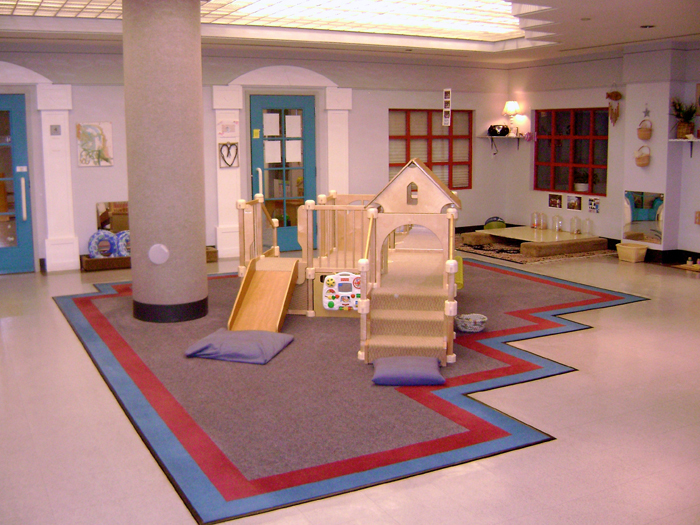
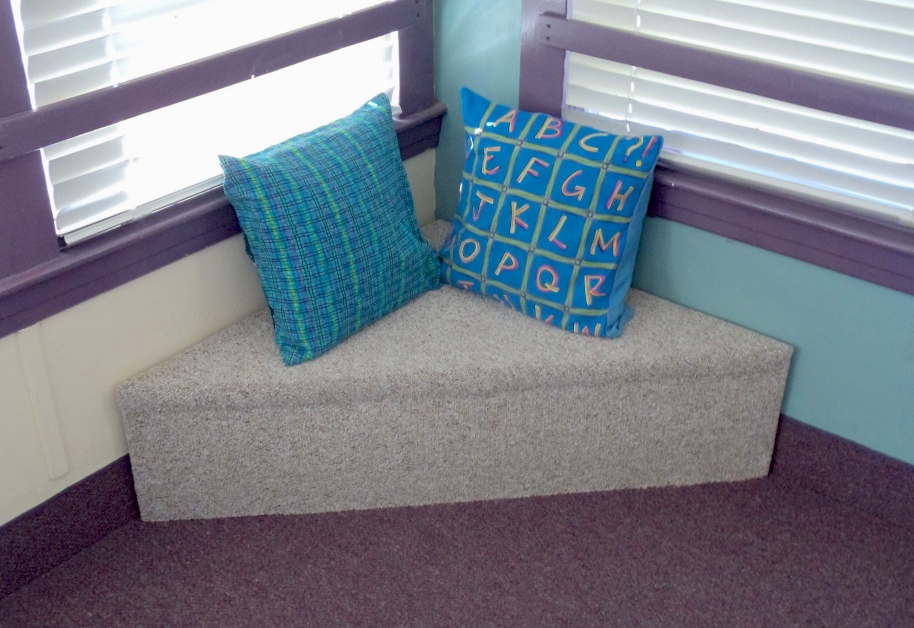
Years ago, I purchased Bear Blocks. These were carpeted, hollow, wood structures – large enough for children to climb on, sit on, lie on, jump from, and sit in. They came in many shapes and sizes, and provided hours of play and numerous cozy spaces for all ages of children. In addition, they offered differing heights and vantage points where children could observe and just hang out. My original builder is no longer available, but I have located a fabulous craftsman who also builds carpeted, wood structures. He calls his product “Soft Blocks,” which he can customize to fit your space and color scheme. In addition, his wife is the director of a children’s center – perfect! You can visit his Facebook site by clicking the Soft Blocks link in the Resources section on the right side of this page. His email address is softblocks@gmail.com.
Clear, fabric shoe organizers (the kind you hang on the inside of a closet door) make wonderful storage for small parts – basters, measuring stuff, tongs, funnels – all of the hundreds of small items that fill sensory tables and discovery shelves. Rotating items is easy, and finding what you are looking for is probably the best selling point of this find (especially when time is of the essence). And, did I mention de-cluttering!

A metal cookie sheet attached with Velcro to the side of a storage unit or shelving unit makes a perfect magnetic surface. It is inexpensive, yet effective – and when you want to make a change, attach something else in its place. A basket of magnetic letters, shapes, or cutouts on the floor beneath the cookie sheet provides an activity for one. Using otherwise unused space stretches the activities and experiences you can offer.

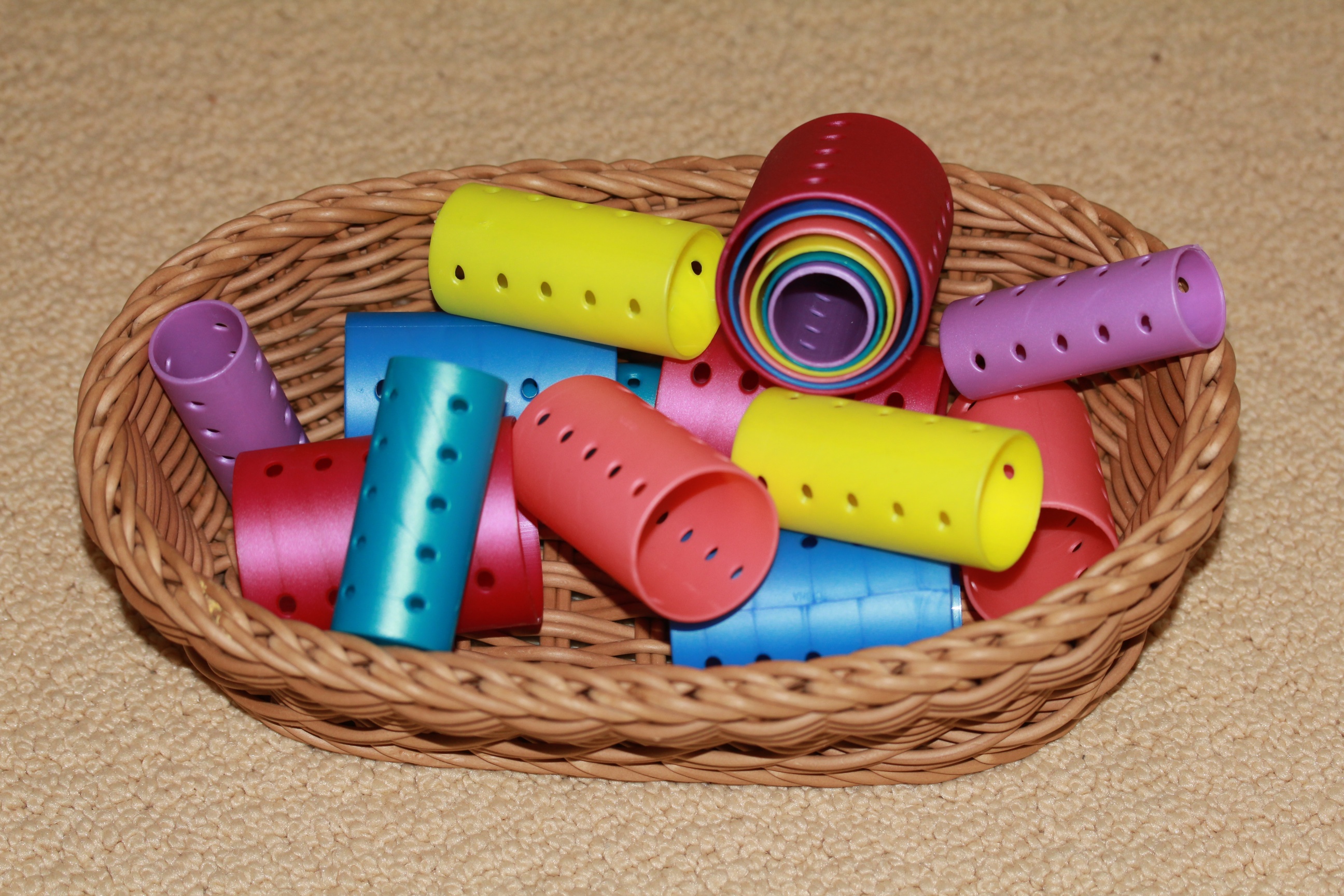
Hair-curling rollers become versatile, open-ended materials for play and exploration. These are the smooth, plastic cylinders that nest in one another. I found these rollers (not to be confused with brush or foam curlers) in the hair accessory aisle of my favorite low-budget store. They are multi-colored, and come in six different sizes. They nest beautifully in one another. No sharp edges and they are dishwasher safe. A basket of rollers engages infants through preschoolers – the play is as varied as the children.
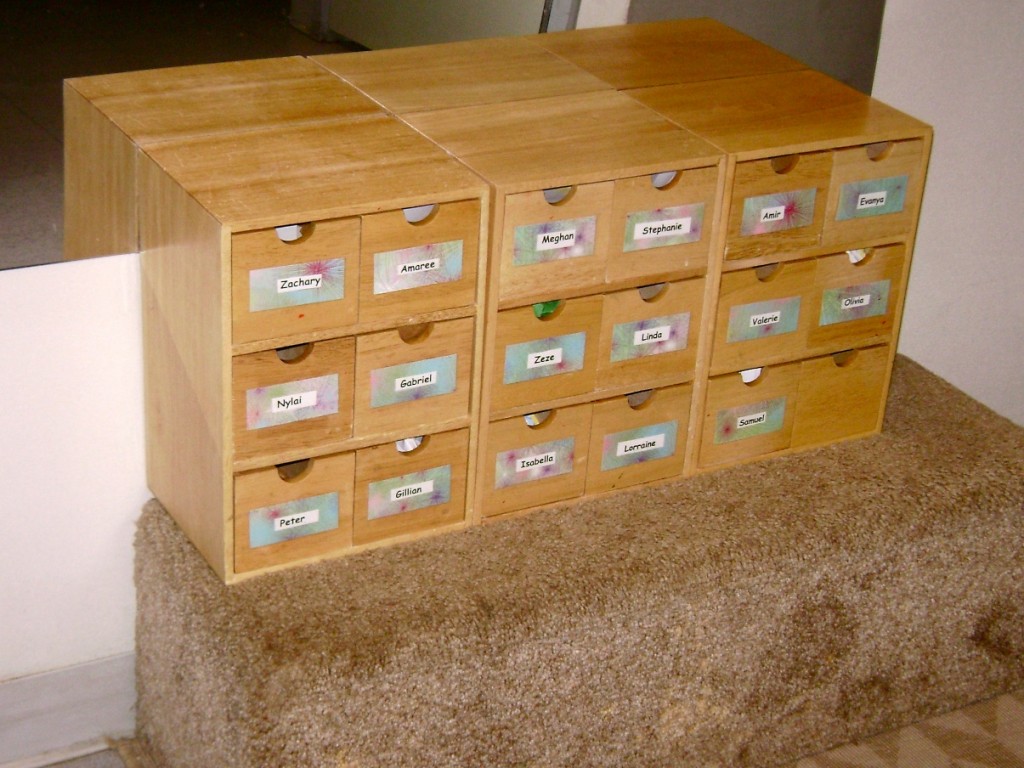
For home-to-school, school-to-home, and school-within-school messages and surprises, we found beautiful wooden boxes – and purchased enough for each of our three to six-year-olds. The boxes have numerous uses, but we are building a “community” in our large program, and two of our goals are making connections and communicating with everyone involved – children, teachers, and parents. These boxes have been perfect for this ongoing project. Messages, happy thoughts, and sometimes treats await the children!

And finally, add herbs! Peppermint and spearmint are easy to grow – and rubbing them to release their scent, and tossing them into the water table or mixing them into sand is a sensory delight.

So, what about you? What have you found, used in a unique way, or delighted in creating?

Please share – your large audience awaits!

Posted in Early Childhood, Early Childhood Leadership, Early Childhood Teachers, John Hancock Child Care Center, Managing Early Childhood Programs, Training for Early Childhood Directors | Leave a comment

Spaces and Places – Thoughtfully Designed

I love creating aesthetically pleasing environments for children! I love the possibilities within each space! I love moving furniture to get just the right placement! I love finding the perfect container for our nature walk treasures! I love adding unique materials to the shelves! And, I love to watch the children discover all that is waiting to be discovered!

Many years ago, when I opened my first child care center, my instinct was to re-create (as closely as I could) the home environment that the children had lived and played in before coming to me.

We had all natural wood furniture, curtains on the windows, and lots of soft spaces. We had baskets of green plants, pottery vases filled with pussy willows, and mason jars full of wild flowers. We baked breads and cookies. Through open windows, we heard the chirping of birds, the wind through the trees. We watched rainbows, shadows, and sunshine on the carpet as the light transformed our space. Outside, we made good use of everything – the pine needled paths through the woods, the pond where we ate snack in our canoe, and the hilly landscape that invited us to roll and roll in the summer and slide on the snow all winter long.

As I look back, I realize that instinctively we were taking our inspiration and shaping our ideas from those places where we experience the world of people and things most fully – through our senses. Our child care environment appealed to our senses of sight, sound, smell, touch, and taste. And, it did so naturally! Everything somehow fit together – the color, the light, the natural beauty, the smells, and the sounds.

And, I learned that it is the aesthetic elements of life that make the world a rich experience. They stimulate and nurture our many moods. They are the elements we have in the places where we live – and I think they are the elements we should especially have in settings where children and adults spend their days together.

I am a huge fan of creating inviting, homelike, and aesthetically pleasing environments for young children. These little ones essentially “live” with us five days of the week. Shouldn’t we strike a balance between the living and learning of their days?

Fast forward to my fourth child care center – thirteen years later.

I am reading early childhood environment trends in one of our professional publications:

“The aesthetic appeal is all about color, lighting, display, texture, nature, sounds, and smells; and the warm, home-like feel is about softness, real-life materials blended into the child’s world of things.”

Sometimes, we just know!

Posted in Early Childhood, Early Childhood Leadership, Early Childhood Teachers, Managing Early Childhood Programs, Training for Early Childhood Directors | Leave a comment

Spaces and Places – The Basics of Designing Infant, Toddler, and Preschool Environments

Who will live in this space?

If we can thoughtfully and in great detail answer this one question, and, in essence, become these children, we will be well on our way to designing environments that meet both the developmental needs and interests of their inhabitants.

We must have a solid foundation in growth and development – the ages and stages – of the early childhood years. In order to create optimally, we need to know where the children are now; where they have been; and where they are going – physically, emotionally, socially, and intellectually – in a few months, by the end of the year. For they will grow during this time and the environments we create will need to remain flexible to keep up with these changes. We must continually observe, reflect, plan, purchase, and place furniture, equipment, and materials appropriately.

The following just scratches the surface of this topic, but it will give us a way to begin our thinking.

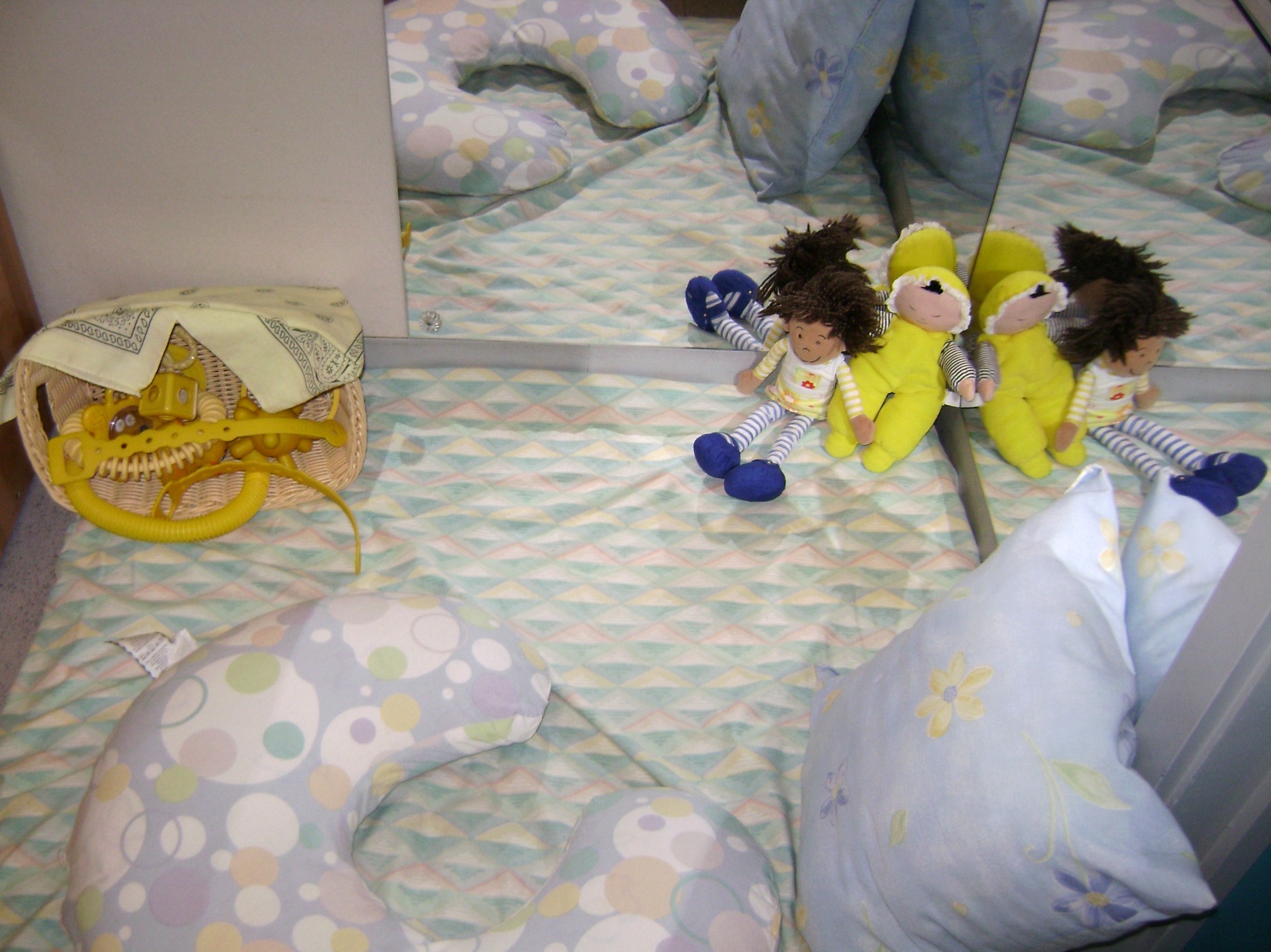
Young infants spend a great deal of time on their backs – looking up. So, we create comfortable, soft places throughout the space where the infants will have a variety of views. We take advantage of natural light. We minimize glare from ceiling lights with diffusers. We arrange protected areas where infants can watch the action from the floor. We provide soft toys. We place pictures at their eye level on the walls, ends of cribs, ends of shelves. We provide pleasant and soft sounds, gentle music. Essentially, we create a peaceful environment.

Mobile infants need safe spaces where they can crawl; low, carpeted risers that they can climb on and navigate; secure rails they can pull on to stand and hold while they cruise; and places where they can walk, fall safely, and walk again. We provide forgiving surfaces and open space. Mobile infants are on the move! In addition, we create soft areas and places to sit with adults, to cuddle, and to be comforted. We organize space for appropriate play experiences – open-ended toys and unique materials to investigate; balls to roll; books to look at; simple props (scarves, hats) for imitating and pretending. If needed, we use low dividers so that children and adults can see one another while children explore freely.

Toddlers and twos need space that is rich in opportunities that support their development. They learn with their bodies! They are physical. We make room for safe jumping, climbing, throwing, tumbling, crawling through a tunnel, and running. These are the teenagers of our programs – independent one minute and needing a snuggle the next. We design their spaces for playing alone initially, and then with another as they grow; for cuddling with an adult; for moving their bodies and anything else not bolted down; for both active and quiet time.

We provide places for creating with art materials; for imitating and pretending; for sand and water play; for stories and books; for playing with toys and other interesting materials; for playing with soft blocks, and for music and movement. We provide duplicate toys – for toddlers and twos cannot yet share. Tables, chairs, cots or mats, shelving units and dividers begin to appear and take up some of the space. This increasingly complex room arrangement later helps twos make the transition to a preschool environment.

Preschoolers live in interesting space defined by learning centers: blocks, dramatic play, puzzles and games, art, sensory table, music and movement, discovery, and books, which now become the library (and includes writing and listening). Optional experiences include cooking, computers, and woodworking.

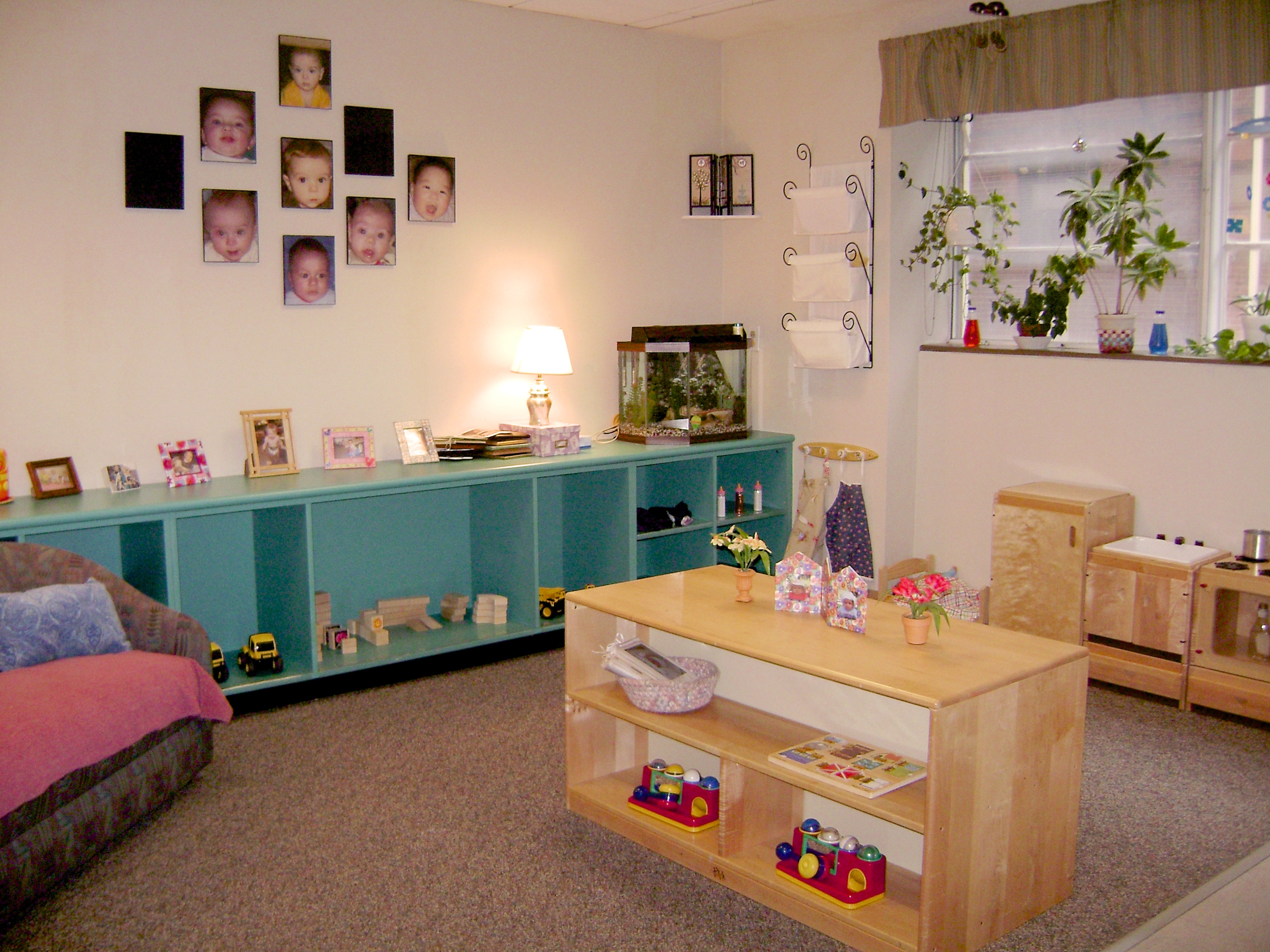
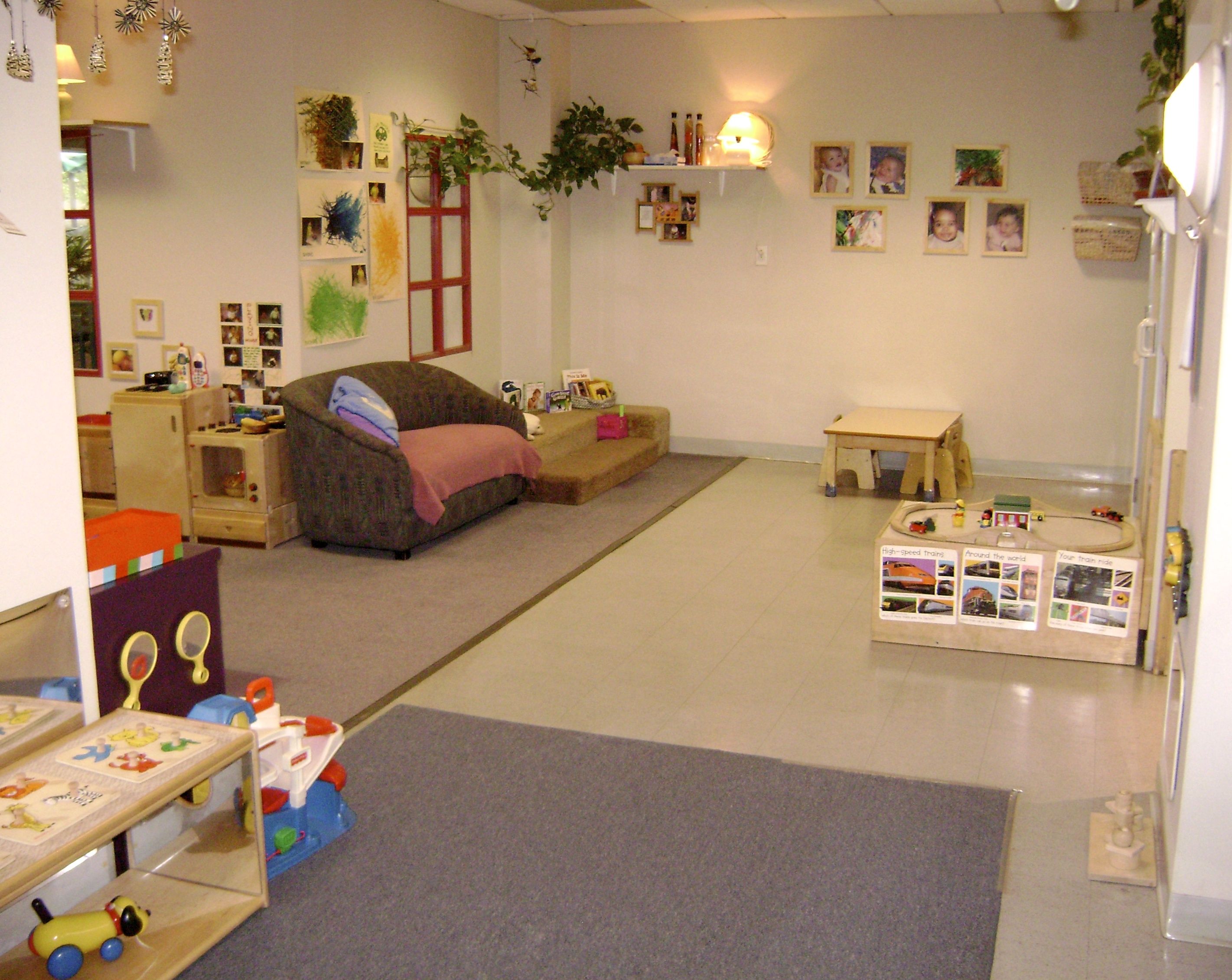
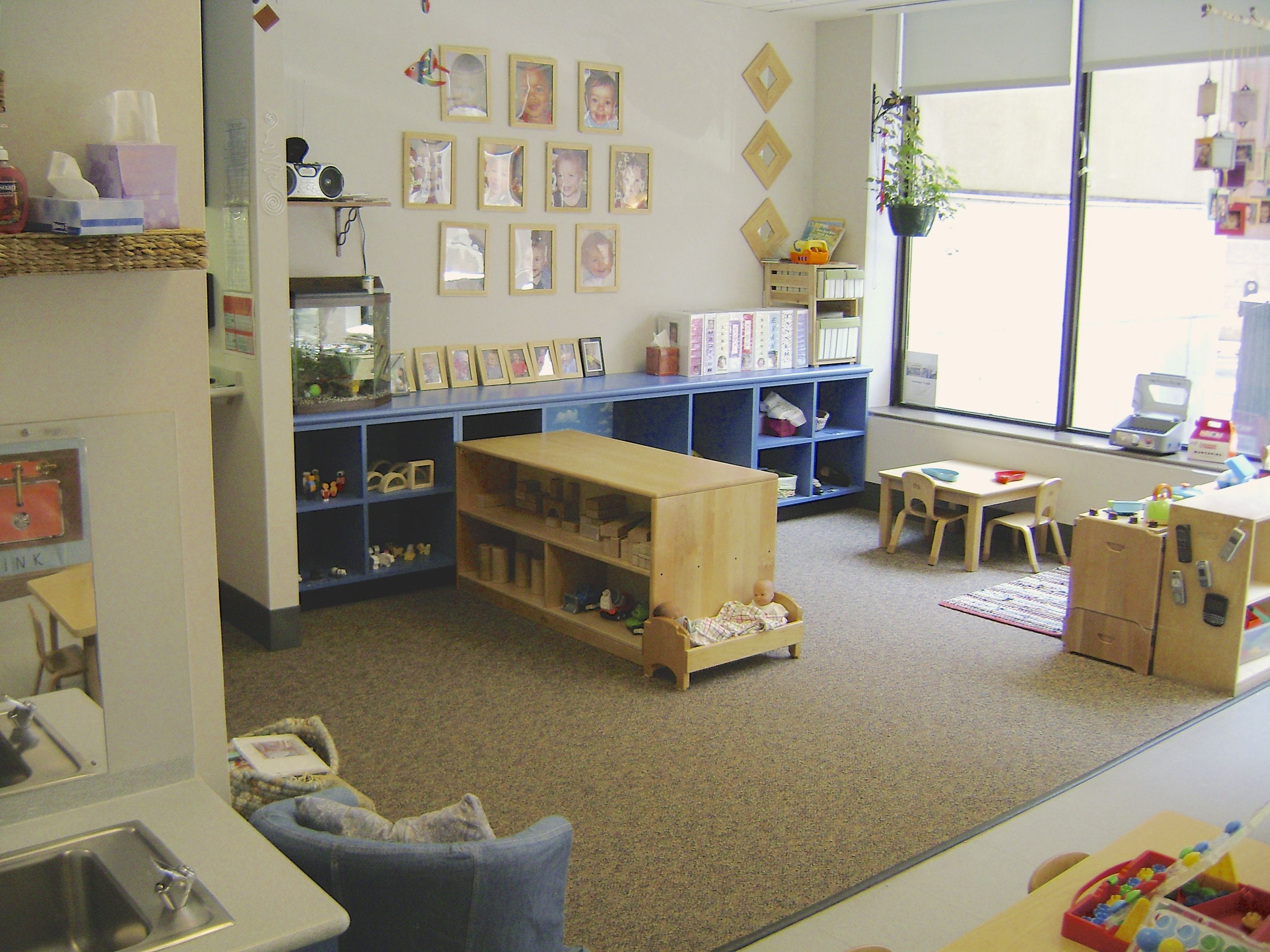
Preschool classrooms are busy with children and filled with materials – the challenge is using the space effectively and efficiently and keeping it organized. We establish traffic patterns for movement from one area in the room to another; we define areas that need protection like block building or a cozy book nook; we locate relatively quiet interest centers away from the noisier ones. We decide which areas need tables and chairs (thinking about size and versatility), and which need water, good lighting, or electrical outlets. We think about washable flooring vs carpeting, and how to use our space most effectively. Everything should have a designated place. All children (and adults) benefit from this kind of order. So, we clearly label storage places with pictures and words. And, if our room arrangement and design is to work well, adults should be able to see as much of the classroom as possible – from every angle.

So, there is much to consider in each of these environments as we make our plans and begin creating.

How to do this takes patience, practice, and perseverance. It is often a trial and error process. When the environment is working for both children and adults, it just hums. Everything flows. When it is not working, the children will tell us what they need by their actions and behavior – then it’s back to the drawing board!

As long as we have a foundation of developmentally appropriate ages, stages, and practice, and, as long as we observe and get to know the children in our care, we will be able to design the basics for them.

But, how do we move to the next level of inviting, homelike, and aesthetically pleasing indoor environments? And, why?

This is my next post!

Posted in Early Childhood, Early Childhood Leadership, Early Childhood Teachers, John Hancock Child Care Center, Managing Early Childhood Programs, Training for Early Childhood Directors | Leave a comment

Spaces and Places

Years ago, when we were getting ready to open the John Hancock Child Care Center in Boston, I had the privilege of working with Jim Greenman (author of Caring Spaces, Learning Places [Children’s Environments That Work] and Places for Childhoods: Making Quality Happen in the Real World). Jim had been hired to design the indoor and outdoor spaces. And, he and I worked closely preparing the space and thinking “out of the box” as to how some of the unique corners, alcoves, windows, and tucked away spaces could become “unexpected pleasures” for our young children.

Jim came to our meetings armed with printed quotes to be hung in strategic places; display boxes for the treasures children would find and share; unique toy boxes that would become anything and everything during play – and many, many beautiful artifacts that both children and adults would enjoy for the next twenty years.

I loved talking with Jim. He could see the world through a child’s eyes – and he ignited the passion in me for creating beautiful, functional child-centered, child-driven environments for them. I often scrunched down to the level of a two-year-old to take in the sights, sounds, and smells while deciding where to place children’s equipment, materials and supplies. And, to this day, I sit on the floor – if given a choice. It has become my way of keeping the focus on our little ones.

Our environment at John Hancock evolved over time, as our brightly-colored plastic lessened and our natural materials increased. Our commercially-made materials gave way to making our own from recycled odds and ends. Our sensory-based environment was pervasive indoors and out with many opportunities for children to see, hear, smell, touch, and taste. Our environment set the stage for all that happened within it.

So, we spent a great deal of time thinking about it in the context of our vision. Was it exceptional and thoughtfully designed? Why did we put that piece of equipment there? Were we thinking about the lighting; did we factor in the interruptions; does it fit; is there an aesthetic value to placing it there? Did our environment meet or exceed the national standards and state regulations? Did our environment reflect the people who “live” in it and the community we had created? And, did our environment reflect the values and philosophy of our early childhood program?

Lots to think about – reflect upon.

I believe that creating thoughtful and intentional environments for children is about opening our eyes, our ears, and our hearts.

Do you take the time to open your eyes, ears, and hearts to what is happening in your space? Are children thriving, or are there many problems? I believe that almost anything that happens during the course of our days finds its beginnings in the environment. So, it behooves us to take a good look at our spaces and places every now and again – to see if they are working for both children and adults.

In the next several posts, I will share some of what I’ve learned about peaceful, harmonious environments; the basics of designing infant, toddler, and preschool environments; making and keeping order; and some thoughts on evaluating your environments. Are you sending the right messages to the children? Are there problems and, if so, how can you correct them by “tweaking” the space?

And, if you have specific questions or comments, please contact me.

Posted in Early Childhood, Early Childhood Leadership, Early Childhood Teachers | 9 Comments

The Partnership

The partnership between the parent and the teacher cannot be underestimated. When it is built on mutual trust and respect, everything else falls into place. Everything!

This poem, by Ray Lingenfelter, says it all:

Unity

I dreamed I stood in a studio
and watched two sculptors there.
The clay they used was a young child’s mind
and they fashioned it with care.

One was a teacher.
The tools she used were books and music and art;
One was a parent
with a guiding hand and a gentle, loving heart.

And when at last their work was done,
they were proud of what they had wrought;
for the things they had worked into the child
could never be sold or bought.

And each agreed she would have failed
if she had worked alone;
for behind the parent stood the school,
and behind the teacher stood the home.

I’ve always loved this poem.

In this life, we don’t go it alone. When we learn how to connect with one another and appreciate what others bring into our lives (and into the lives of our children) – how rich it all becomes.

If you would like to further discuss the parent relationships in your program, contact me at marciahebert@earthlink.net. I have lots to share.

My next series of posts will focus on Environments for Children.

Posted in Early Childhood, Early Childhood Leadership, Early Childhood Teachers, Managing Early Childhood Programs, Training for Early Childhood Directors | 2 Comments

When Parents Have Concerns

Even in the most competently run early childhood programs, parents have concerns and sometimes complaints. And, they have a right and a responsibility to express their concerns and to receive thoughtful responses.

There are some general strategies to use in these situations – strategies that will also help us continue to build positive relationships.

Give these concerns your immediate attention.

Find a place to talk privately and invite conversation. If the parent is too emotional to have a conversation, let the parent vent (getting everything out now will diffuse some of the initial emotion). And, set another time (within twenty-four hours) to have the conversation.

Meanwhile, we can gather more information from the teachers’ (perspective) and begin to piece the problem and a resolution together. If a parent concern is passed on to you by someone else, make contact with the parent as quickly as possible. The longer a person stews about a problem, the more confused and out of proportion it can become.

Listen closely.

Be fully present. Keep an open mind. Get all the information from the parent (perspective). Let your concern show. And, avoid reacting before you have heard everything the parent wants to say. This one is tough, because the temptation to jump in is so strong. Patience, patience, patience at this time will set the appropriate tone for resolution.

Summarize the issue in your own words.

Before you end your conversation with the parent, repeat the issue in your own words. This approach serves two purposes: the parent is reassured that you have listened and that you understand; and, you both know that you agree on the issue.

If there has been an error, admit it.

Sometimes, we make mistakes. I “growl” when this happens. I also find it helpful to take the blame for whatever, whomever, and then move quickly to how we can correct the situation. Our honesty will be appreciated – admitting a mistake is one way to build trust. This I know, an apology goes a long way.

Enlist parents help in solving the problem.

What will it take for the parent to feel that the situation is being handled appropriately? How will we be sure the problem does not repeat itself? Together, decide what might be done to remedy the situation and develop a plan.

Set a date to evaluate the success of the plan.

If you develop a plan, and it is working to most everyone’s satisfaction, wonderful! If not, go back to the drawing board and try something else. I have found that as long as people know you are working on the problem, they are likely to stay with you and continue to help with the resolution.

Let a parent know when a policy will not change.

Policies in early childhood programs have been written because they insure the well-being of children first; they have been written to be in compliance with state and national standards; and they are the foundation of the operating organization. There’s no wiggle room in a policy. It is what it is.

When a parent’s complaint is not one you are able to do anything about (for example, changing your policy on sick children at school), express understanding and explain the reasons you must keep the policy as is. I have found that parents appreciate knowing the reasons, the rationale, behind everything!

Always treat the parent with respect.

We say this so often, it should be a “duh” moment – of course we should always treat parents with respect! But, I think sometimes we miss the mark and get tangled up in an emotional joust with a parent.

I think it is important that each person leave every conversation with self-esteem intact. Parents who have expressed a concern and feel they have been treated well will also be assured that you care.

“People don’t care how much you know until they know how much you care.”

Truer words were never written.

Thank parents who express concerns. Let them know that you think of them as partners.

As a director, I reflected upon every interaction with parents. I found it extremely helpful to write down what happened during the conversation – what was spoken, what was not spoken, and how I felt. I always learned something – for the next time. For there would always be a next time.

I’d love your thoughts on this topic. What have you tried that works? Please share –there is a large readership here, and we can all learn from one another.

Posted in Early Childhood, Early Childhood Leadership, Early Childhood Teachers, Managing Early Childhood Programs, Training for Early Childhood Directors | 2 Comments

Parents Can Teach Us About Their Children – If We Ask Some Good Questions

As early childhood educators, helping relationships develop naturally and authentically between parents, teachers, and children is what we do. Some of us do this with ease. Some of us need a little guidance. And some of us have used the strategy of building the parent relationship through the child with much success.

Parents have the inside scoop on their child; they already know what makes their little one “tick.” So, let’s tap into this parent wisdom; learn what they have already learned about their child; and begin the dialogue by focusing together on their child. By doing this, a couple of wonderful things will happen: We will know much more about the child, and be able to more quickly meet his individual needs. And we will gain the trust of the parents when we include them, their experiences, their expertise, and their thoughts, in our world.

To get at this “parent wisdom,” we can ask thoughtful and intentional questions about their child. And then, we can listen closely to the answers that will undoubtedly give us more insight into this child and this family. I’m not suggesting a questionnaire to be completed by the parents. But, rather, engaging questions that can, and should, be asked over time; asked informally, naturally, without effort, and when the appropriate moment presents itself; asked during relaxed and enjoyable casual conversation.

Getting the parents’ perspective on many topics and learning from them will build a partnership based on mutual respect and trust. The give and take of positive conversation is a plus. Each interaction moves us toward our goal.

Should a problem arise, what we learned can be pieced together to help us better meet the needs of the child and family. And, down the road, if that difficult conversation is needed, the foundation for it will already have been built.

Here, then, are a few examples. They are essentially conversation starters. They are questions that will get to the heart of the child – the answers to which will uncover a little bit more of the child’s spirit, temperament, family culture, social-emotional health, physical health, learning style, and interests.

  • How did you choose your child’s name?
  • What especially delights your child?
  • What brings on the giggles?
  • In what type of a setting is your child most likely to be quiet? more outgoing?overwhelmed?
  • What does your family consider good behavior – for your child’s age?
  • Are there traditional family games or songs your child enjoys?
  • How does your child like to start the day?
  • If overwhelmed, what are ways you and your child cope?
  • What are typical signs of illness? do they come on quickly? slowly?
  • What are sure signs your child is hungry? tired?
  • At what times is your child most likely to be talkative?
  • What does your child enjoy doing when playing alone? when playing with adults? when playing with other children?

Think what we could learn from the answers. Could we better accommodate each child and family if we had the answers? 

We can learn a lot from the parents in our programs. To recognize that they have much to teach us is the first step in building the partnership.  And, when we have their trust, they will share with us.

Posted in Early Childhood, Early Childhood Leadership, Early Childhood Teachers, Managing Early Childhood Programs, Training for Early Childhood Directors | Leave a comment

Our Relationship With Parents

Ah, parents!

In our early childhood programs, parents are the third leg of a three-legged stool – the children, the teachers, and the parents. When all three are in balance, so is the stool. The stool can be a metaphor for our classrooms, our programs, or our organizations. The parents are a key component in each.

To the director of the program, there is nothing more important than getting this stool balanced! The relationship between the children, the teachers, and the parents is the foundation for everything that happens in our early childhood world.

The goal is for teachers and parents to think similarly:

  • That children’s rights and needs be recognized in the early childhood program.
  • That children have high quality care and education that supports the development of their potential.
  • That parents are their children’s first teachers and, as such, are active participants in their learning experiences.
  • That teachers partner with children, offer them possibilities and opportunities, and facilitate their self-discoveries.

Each leg supporting the other and building a solid foundation.

But, how many of us ever thought about parents when we became teachers? Didn’t we become teachers because we love being with, and working with children? Who even considered the parent component?

I can tell you, not many! When I ask this question in training sessions, people simply shake their heads.

But, when a new child comes into our classroom, it’s a package deal. With one, comes the other – the child and the parent.

I envision children with parents on their first day at the front door, both dressed like Paddington Bear with notes pinned to their coats. And, interestingly, it is the same note for both. It reads, “Please look after me!”

And both, the child and the parent, do need looking after, and taking care of.

This is all new to them – going to school, leaving one another. There is much that is, as yet, unknown to them. They are both anxious and looking for reassurance. And sometimes we forget this. Our training prepared us to help children. We focus on the child and assume the parents are fine. Our training should prepare us to support the parents as well. Because just under the surface lies their biggest worry, their biggest concern, that goes unsaid.

What parents really need from us; what parents are really asking for in all of their questions; what parents really want to know is, “Do you know and love and really care about my special child?”

And, we do! Sometimes we communicate this successfully – sometimes we do not!

In my next few blog posts, I will share what I have learned about parents – and how we can build effective partnerships with them. My most recent director position at the John Hancock Child Care Center in Boston was my most challenging. With two hundred children, four hundred parents walked through my front door!

That was one big stool to balance! As a result, I learned a lot!

I have found that the more we practice “being the parents,” and walking in their shoes, the more we understand, and the easier it is to build that partnership. It takes patience, sensitivity, and time to build the necessary trust and respect.

I believe that when we can see things through parents’ eyes; hear things as parents would hear them; and feel all of the feelings parents carry for themselves, for their child, for their family, for their work, for their world, and for their circumstances, our relationship with them will vastly improve. As a result, the work we do together will no longer be “us and them,” but “we!” We will be looking after one another.

The long and the short of it is this: Building positive relationships with parents is about opening our eyes, opening our ears, and opening our hearts!

Your thoughts?

My next post: What Parents Can Teach Us About Their Children – If We’re Asking the Right Questions!

Posted in Early Childhood, Early Childhood Leadership, Early Childhood Teachers, John Hancock Child Care Center, Managing Early Childhood Programs, Training for Early Childhood Directors | 2 Comments

A Look Back …

This past year I have had the privilege of working with numerous directors of early childhood programs, as well as their teams of teachers.

I presented training that ranged from building effective teams, to creating warmer, homelike environments; from finding and using unique materials and activities for children, to building collaborative relationships with parents; from learning how to set goals and then moving toward meeting them, to de-cluttering spaces for children and de-stressing everyone in the process.

I coached and mentored aspiring, new, and experienced directors alike – at their schools, over the phone, and via email – troubleshooting, and finding solutions to staffing, space, organization, the rhythm of the day, transition, parent, and child situations. I observed both teachers and children – as another set of eyes and ears for the director – helping to make changes as needed. And, I consulted and strategized with directors who were opening new programs; directors who were expanding their programs; and directors who were closing their schools.

I have been pleased to experience, time and time again, the level of commitment, dedication, passion, and enthusiasm of these directors and teachers. They are reaching for quality. And, it has warmed my heart, because I know that the children reap the benefit by having wonderful early childhood experiences.

Recently, I returned to a program to retrieve my Sophia. Sophia is a puppet with spiky gray hair, wrinkles, and a long, black dress. To children, Sophia is real.

But, let me back up a bit. I was consulting with an early childhood program this past fall, and when I walked into one of the preschool classrooms, there was their puppet, Gloria, sitting on the sofa. Gloria is an identical twin to my Sophia! Can you believe it! Anyway, an animated conversation took place between the teacher and the children. And, I agreed to bring my Sophia to this busy room of preschoolers for a play date and an overnight. Well, apparently, the two puppets and the children had a wonderful time together, because, when I arrived at the school to retrieve my Sophia, I was greeted with stories, pictures, and a play-by-play of the Sophia/Gloria adventure:

“They had slept on the sofa under the peace quilt.” (that’s a story for another time)
“They weren’t afraid of the dark – they had a night light.”
“Gloria gave Sophia her necklace.” (a beaded one that the children made)
“Gloria and Sophia are going to be pen pals.”
“Could Sophia come back for another play date?”

And just before Sophia and I left, the entire classroom serenaded us with “Twinkle, Twinkle Little Star” – Gloria’s screeching voice heard above all others! Sophia and I blew kisses as we left the children and teachers. Pure magic!

Gloria is a treasured part of this classroom. To the children, she is real. They talk with her, care for her, worry about her, include her in everything. She listens, and whispers her thoughts. She is the voice for many of the “unspoken” things young preschoolers think about. And she is their friend.

The teacher who has added this puppet experience to the classroom is a masterful teacher of young children. She has added another dimension to an already rich program. In fact, a gift to everyone in the school – for Gloria is known and loved by all of the teachers, parents, and children!

Pure magic!
Isn’t this what working with young children is all about?

I observed many magical moments this past year, as I moved from program to program and built relationships with the directors, teachers, and children. What a privilege to observe so many wonderful things happening for so many.

Our early childhood colleagues (directors and teachers alike) are doing extraordinary work with the young children in their care. They love what they do! And, there is the desire to want to do it better.

I saw the passion in their eyes; heard the enthusiasm in their voices; and noted the strong commitment to quality in their words and actions.

We are fortunate to have such people in our programs. As we know, it begins with a few, and then ripples throughout the organization. And, as we also know, it begins at the top.

As a director, are you creating a climate for magic?

Posted in Early Childhood, Early Childhood Leadership, Early Childhood Teachers, Managing Early Childhood Programs, Training for Early Childhood Directors | 2 Comments

Let them be Little

“… let them be little ‘cause they’re only that way for a while
Give them hope, give them praise, give them love every day
Let them cry, let them giggle, let them sleep in the middle
Oh just let them be little”

These are the words to a song by Billy Dean, and every time I hear them, something stirs deep within me.

The longer I live, the less I understand the rationale behind the “rushing,” the “hurriedness,” the “sense of urgency” that accompanies everything we do today. Why the fast lane? Where are we going? What are we racing to?

Many of us today are preoccupied – we are multi-tasking. There is too much to do, too much to know – all of it overwhelming to the spirit. Life is passing by and we are missing so many of the ordinary moments – moments that, as we know, are anything but ordinary! These are the moments that will tell the stories of our lives; but, if we are hurrying through life, we are likely to miss them.

I am most concerned about what this “hurriedness” does to the youngest of our children. They are often swept along in the current of the adults in their lives. They have no control, and no say in the matter.

But, this “rushing” does go against children’s nature. There is certainly a disconnect to their own sense of time and their personal rhythm – which is, in a word, leisurely.

For them, can’t we slow things down? Can’t we let them be little? Can’t we follow their lead?

I marvel at children’s powers of concentration and focus when they are thoroughly absorbed in something. Nothing can move them from the task at hand. And we celebrate that the children are so engaged, and are learning so much from the experience.

Yet, we disturb all of this by ringing a bell, clapping our hands, turning off the lights, or (one of my pet peeves) yelling across the classroom that “it’s cleanup time!” We tell the children that we need to hurry, so that we can get outside on time. And, we begin to hurry – in our voices, in our actions – as we disturb the child’s activity and the tone of the classroom.

The damage has been done – the magic of their moment has abruptly ended. Abruptly. No winding down; no opportunity for the children to figure out how they can continue their activity later in the day. No thought given to their interests, their imaginations, their conversations, their problem-solving – and their JOY!

We have to move on – now!

We know this happens every day in our classrooms. But, does it have to?

Couldn’t we just let the play, the children’s work, continue – for those who are so engaged? Must we interrupt their focus and make the transition to snack at exactly 10:00 – for everyone? Couldn’t we think about another way to make snack available to the children – when they are ready for it?

Couldn’t we intentionally slow down our adult pace and consider the children’s needs (their sense of time and personal rhythm) when planning and carrying out activities and projects? Couldn’t we re-visit the amazing block structure later in the day – and not tear it down right now?

Couldn’t we provide sufficient time for them to be together with friends? to get things done with satisfaction? Couldn’t we allow the children plenty of time to complete their drawing, their book, their make-believe, so that they control the start and the finish.

Couldn’t we provide the time for our young children to enjoy the process of learning? to experiment? to make mistakes and readjustments? to complete a task? to laugh? to engage with others? to have fun? to be little?

Lots to consider and reflect upon.

To my way of thinking, nothing is more important. I’d love your thoughts.

Posted in Early Childhood, Early Childhood Leadership, Early Childhood Teachers, Managing Early Childhood Programs, Training for Early Childhood Directors | Leave a comment