
Coping with Change – Strategies for Weathering the Storm

“It is not the strongest of the species that survive,
not the most intelligent,
but the one most responsive to change.”
                                                  Charles Darwin

And, isn’t that the truth!

In my work as director of several early childhood programs, one of the important lessons I learned was that, as in my life, the only constant was change! Just when I’d get the staffing set – hired, oriented, and working together as a team – the enrollment would shift. Or, when the enrollment was at capacity, key teachers would make life changes and resign. The balancing act between having the appropriate team of teachers for the enrollment at hand was a constant challenge. It was always back to the drawing board! Over time, though, instead of reacting to it when it happened, I began planning for it in advance.

Another important lesson I learned was that problems and situations never arrived one at a time; rather, many happened simultaneously and, simply came out of the blue! With teachers, parents, children, and everything that accompanied these three groups; along with the environment, our facility, health and safety, funding, and the budget, the potential for a problem was always there. And, with each “situation” came the need to take action and, often, to make some kind of change. Some were small changes – hardly noticeable – but every now and then a major overhaul was necessary.

Today, we live in an age of instability; so, to think more proactively, and plan for the inevitable or, to actually make the changes needed, is a matter of survival, not choice.

“We can’t wait for the storm to blow over,
we’ve got to learn to work in the rain.”
                                                        Peter Silas

However, not all team members will see these necessary changes the same way. Many will feel insecure, confused, or uncertain. They may also feel a deterioration of trust, and a sense of self-preservation. And, while we are making the sound decisions we must make for our organizations, know that (disguised as feelings of betrayal, shock, denial, or disbelief) there will be resistance. A few on our team will actually resist the change by trying to sabotage our efforts. This will be harmful at first, but will ultimately backfire, because these people will be seen as getting in the way of the solution – people who are no longer part of the team; people who can no longer stay. Many more on our team will accept that our organization is not changing to make our lives miserable; they will listen and trust that we are doing the appropriate things, and they will grab hold of the future. A new team will be created.

“Coming together is a beginning,
Keeping together is progress,
Working together is success”
                                     Henry Ford

Throughout the change, our work as directors will be to communicate, communicate, communicate! When we strongly communicate a clear vision for our organization – even if it changes every week – the vision will keep our teams from drifting. Any silence on our part will be interpreted as unfavorable. In the absence of information, people make things up and, inevitably, it is hurtful and creates panic. As directors, during periods of change, we must force ourselves to be on the front line. Even though we may be reluctant, don’t hide behind the closed door of our offices; get out and among our team members – it will boost morale. Invite people to talk – it will increase our credibility and help us to uncover bad news before it becomes terrible news. When we can’t give answers (because of confidentiality), we can instead promise change, but sell it carefully – things will be different; there is both good and bad news; I’ll be straight with you. Always, always protect our “director” credibility.

As the leader of our organizations, what else should we be doing during this time of change?

  • First, before anything else, we must manage ourselves.
    • Keep a positive attitude, but be authentic. Be enthusiastic. Be curious about the challenges and possibilities. Be interested in the opportunity to repair, solve, or create.
    • We must manage our emotions. They affect not only us, but the entire organization. Keep a lid on venting and expressing ourselves inappropriately.
    • Most importantly, be the leader. Seize the day. People in transition want to be led.
    • Step up to the plate – make the difficult decisions and act on them.
  • We must also manage our teams, and put a great deal of energy into this!
    • Raise the bar. Keep them busy, focused, challenged, stretching, and achieving.
    • Motivate to the “nth” degree. Harness turbulence into positive energy. Harness concern into curiosity. Harness nervousness into attentiveness.
    • Re-recruit our best teachers. Our best teachers will jump ship if we don’t take care of them. Treat them as coveted applicants. Orient them to their new job description (the result of the change) as if we were orienting them to the organization for the first time. We do not want to lose any one of our top performers to our competition. Rather, we want to keep the best as the core of this new team. Create a supportive environment for them. Model the desired behavior.
    • Break the seemingly overwhelming tasks down into bite-size steps. Accomplish together; build on each success; and celebrate!
  • Guide our teachers during this time.
    • Take the lead and advise them throughout this change as well. They are looking to us for confidence, calm, and support.
    • To my teachers, I would say: Control your attitude – especially now. Breathe deeply before you speak. Take some ownership of the change. Choose your battles carefully. Keep your sense of humor. Don’t let your strengths become your weaknesses. Practice good stress management techniques. Invest in the future instead of trying to redesign the past.
  • And, for all of us moving forward in this ever-changing world, here are a few other work habits to cultivate:
    • Become a quick-change artist. Flexibility and adaptability in any situation will win the day.
    • Commit fully to your job. Which means doing whatever it takes to get the job done – well.
    • Keep moving forward. Meet or exceed all job expectations. Be the best you can be.
    • Accept ambiguity and uncertainty. It is temporary during change. Focus rather on the positive end result.
    • Behave like you are in business for yourself. See problems from the more global view – and support your director.
    • Keep learning; take classes. Keep growing and adding to your skills and expertise.
    • Hold yourself accountable for outcomes. And, make certain the outcomes are positive and successful.
    • Add value. Every way you can! “How can I be of service?” Go the extra mile.
    • Manage your own morale. You are responsible for you!
    • Alter your expectations as circumstances warrant. Changes take time, so be patient and adjust your thinking and react accordingly.

Finally, since we directors make changes to solve problems, to fix untenable situations, to get back on track, to get better in our work as we, ultimately, reach for the stars, I leave you with this:

EXCELLENCE … can be attained if you:

          CARE more than others think is wise …
          RISK more than others think is safe …
         DREAM more than others think is predictable …
         EXPECT more than others think is possible …
                                                                               Unknown

Posted in Early Childhood, Early Childhood Leadership, Early Childhood Teachers, Managing Early Childhood Programs, Training for Early Childhood Directors | Leave a comment

Managing Effectively – Reining in the “Time Robbers”

If you ask child care directors anything about their work, inevitably you will hear, “There isn’t enough time to accomplish everything that needs to be done.” Those of us who have been in this position, know that it is nearly impossible to focus on important issues when we are bombarded by interruptions (telephone calls, drop-in visitors, scheduling glitches, last minute meetings, spontaneous conversations). We quickly abandon our scheduled task at hand when we are confronted with the spontaneous and pressing needs of children, parents, and staff. These “time robbers” are the results of people and expectations outside ourselves, over which we seem to have little control.

But, there is also another group of “time robbers” – our own behaviors, and attitudes within us that inhibit our capacity to plan and act with purpose and direction. These can include: the inability to delegate; not setting priorities; inviting interruptions; lack of organization; setting unrealistic deadlines; open door policy; procrastination.

As director, do you delegate tasks that can be done effectively by others? Are all 20 items on your “to do” list really priorities? Do you interrupt conversations or meetings to answer the phone? Are you focused on the present moment? Do you multi-task and feel scattered? Can you find papers when you need them? Is your desk de-cluttered and organized? Are you on time for meetings? Do you over-promise and under-deliver? Are you “always available” to everyone for anything? Do you procrastinate and put off doing the things you really don’t want to do?

When we begin to take a closer look at how we spend our time, we can begin to control it, and become more productive in the process. This is the essence of effective management.

Peter Drucker, one of the most widely influential thinkers and writers on the subject of management theory and practice, believed that at the heart of all effective management is the art of managing oneself. He emphasized the importance of changing the focus from what you are doing to how you are doing it. Becoming more effective at work means first recognizing and understanding what stands in the way of making productive use of time.

Mark McCormack, author of What They Don’t Teach You at Harvard Business School, had a simple and straightforward four-point strategy – organize yourself, establish written priorities, focus on the important, and set realistic deadlines and stick to them.

Organize yourself by keeping a daily log for several days and recording what you do, and when – to find out how you use your time. If you can’t do this yourself, have someone shadow you and take notes. A little analysis is extremely helpful in revealing the most obvious time robbers. Then you can dig deeper and reflect on those things that might require a change in your expectations, organizational skills, or work habits.

McCormack wrote that, “Written plans are the essential time control tool against which all future commitments are considered.” Write down your goals, methods, and tasks. As you do, you can often recognize problems and the strategies to solve them – before they happen. In addition, revise and review daily and weekly plans at the end of the day. Making a plan for the next day helps us to stay on track, so that we are not pulled off course so easily.

R. Alec Mackenzie, author of The Time Trap, said that, “Trying to do everything requires no judgement. Deciding on what is important and striving to cover those aspects well is what managing is all about.” Understand where significant results lie in your work and focus your energies on the actions that will achieve them. Our job, as leaders, is to think globally – see the big picture – the end result – our vision. Our focus should be ever moving forward to accomplish that overarching goal.

Know your own time clock and plan accordingly. If early morning is your best time for reflection and decision-making, schedule uninterrupted time in the morning. Be conscious of the times of the day when teachers most frequently need to see you. In addition, be conscious of parent schedules, and use arrival, lunch-hour, and dismissal times to their advantage – and, be available then.

Be careful to allocate enough time to each activity being scheduled. Most of us underestimate our time requirements for a given task – and then fall behind for everything else. One recommendation is to build in a contingency factor of 20% unplanned time to allow for time lost during interruptions, emergencies, drop-ins. A safety net! I am a huge advocate of building in safety nets into my workday – because “Life Happens,” and I refuse to be a crisis manager who is flailing and out of control!

There are also some tips that will help protect our physical workspace from “time robbers.”

  • File the work as soon as you complete it. Many of us have a tendency to make piles and place everything on the desk, so it is not forgotten. Eliminate copies of, and outdated, information, and retain only the “need to have” paper. Create a filing system that works for you and file everything, except what you are working on.
  • Try to handle a piece of routine paper only once; if you are unable to finish the task, make some progress towards its completion.
  • Throw out as much as possible.
  • Daily sort mail into three categories: immediate, this week, and non-immediate. Then, sort the non-immediate into files that correspond to the week in which this correspondence will be handled. At the beginning of each week, go through the current week’s file and prioritize. Tend only to the current week’s work. Recheck priorities during the week to be sure there hasn’t been a shift in what needs to be done.
  • Keep a copy of every written transaction file in order by date. Over time, you will see a pattern of events and tasks which can help generate long-range planning.
  • Because unplanned phone calls consume an enormous amount of time, try to have all incoming calls screened by someone who can prioritize them – or let voice mail do its job. Listen, after the message has been recorded, for any emergency or time-sensitive call. Other than that, return routine phone calls during a pre-scheduled block of time. By planning a call-back time, your concentration at the moment  is not interrupted, you are prepared, and you can devote your full attention to the concerns.
  • Encourage staff to drop in or schedule meetings with you during designated blocks of time. When unscheduled visitors come in while you are absorbed in a task, tell them, and arrange to see them in their classroom at a later time. Follow through!
  • Keeping your door closed when you need to concentrate can clue your staff to your need for some uninterrupted time. An open door is always an invitation for drop-in business that might wait if the individual knows the director is absorbed in another task.
  • Delays with board and faculty committees can be reduced with the use of the Unless I Hear memo. This type of note sets forth a course of action that will be followed at a given time unless a response is received within the specified timeframe within the memo.
  • When you find yourself procrastinating over a difficult task, try setting mini goals, tackling manageable parts of the task a little at a time – until you accomplish your goal. Don’t forget to reward yourself each step of the way – it is motivating!

During my career as the director of several programs, I tried numerous ways to eek out more time during the workday. Some strategies worked, some didn’t. But, in my final years as a director, I created a plan that worked really well for me. I planned a week at a time. I mapped out each week; grouped “like” tasks together; did things at the optimal time of the day (for the children, teachers, or parents); stuck to my plan, and knew that what I had planned would be accomplished by the end of the week. This happened! And, I noted that not only was I really productive, but I was very calm as well. These were great years for me professionally. I was managing effectively and fully enjoying my work!

I would be happy to share that plan with you. It made a huge difference in my days! I was at my best – because I could focus on the present moment and give it all my energy. I knew that I had planned “to do” everything else later – and later would come – and be another present moment. I didn’t worry; I wasn’t overwhelmed; I wasn’t ever in a crisis mode. I was organized, calm, and confident that everything would get done on time. And it did!

I am happy to share that plan with you. Just let me know – send me an email or call me. See my contact page for my contact information.

And finally, if you have any tricks, tips, or strategies that have worked for you, please share. We continue to learn so much from one another…

Posted in Early Childhood, Early Childhood Leadership, Early Childhood Teachers, Managing Early Childhood Programs, Training for Early Childhood Directors | Leave a comment

The Delicate Balance Between Work and Life …

As the manager – of a home, a classroom, a school, an organization, a business – our weeks are filled with details – hundreds of details that need our attention. We must deal with hundreds of pieces of paper; hundreds of conversations, emails, or text messages; hundreds of interactions – in person, over the phone, or via Skype or FaceTime; and hundreds of tasks to be completed. All of this takes focus, skill, a bit of juggling, and extraordinary organizational ability.

And, most of us have both a career and a family, which easily doubles the details we handle. How do we do it all? And, how do we balance the demands of our work and our life?

Strategies, tips, short-cuts, realistic expectations, setting priorities, managing stress, and cutting ourselves some slack in the process of living and working help greatly.

For several years, I was the Director of Work Life Programs for a large business in Boston. My job was to support our 6,000-strong workforce by helping them to find the balance they sought between their work and personal lives. Without balance, we cannot be effective in either arena. So we added relevant informational programs, educational seminars, resources, and discussion groups to what we called our “lunch and learn” workshop program/schedule.

Because the world is moving at an even faster pace today, and finding balance between work and life is still a goal to attain for many, I have included some resources we found helpful. My hope is that you will, too. The following are all available through amazon.com.

The Art of Self-Renewal: Balancing Pressure and Productivity On and Off the Job, by Barbara Mackoff. Ideas for working productively without working yourself to death. Tips on managing stress and balancing work with the rest of life.

First Things First, by Stephen Covey. More life management strategies from the author of The Seven Habits of Highly Effective People.

Getting Organized, by Stephanie Winston. Practical tips on using time more efficiently, including ideas for organizing papers and belongings, managing family finances, and teaching children to be organized.

Organized to Be the Best, by Susan Silver. A practical approach to organization skills and time management, with reviews of available resources – from filtering systems and labeling devices, to software and personal information managers.

The Relaxation Response, by Herbert Benson. Simple meditation techniques that can be used to relieve stress.

Time Management for Unmanageable People, by Ann McGee-Cooper. Alternative organization ideas for those who don’t respond to traditional time-management techniques. Suggestions for “visual organizers” who like to keep their work out where it’s easy to find.

The Power of Doing: 12 Strategies for Taking Control of Your Life, by Ivan Burnell. Workable strategies for accomplishing whatever you want in professional, personal, financial, and spiritual life. Includes self tests and tips for how to change.

The Stress Management Source Book, by J. Barton Cunningham. A principle-centered approach, with information on how to deal with stressful work situations, life transitions, and loss. Includes self tests, cites research, and offers catchy sayings.

The Complete Idiot’s Guide to Reaching Your Goals, by Jeff Davidson. Covers all aspects of developing and implementing goals in seven areas of life. Includes lots of tips, work sheets, illustrations, and side bars. Includes a good section on career goals.

Taking Charge: Every Woman’s Action Guide to Personal, Political, and Professional Success, by Joan Steinau Lester. Explores challenges of change and the effect on the role of women. Offers a 10-Step action plan for achieving goals, realizing potential, and balancing life.

The Working Parents Help Book, by Susan Crites Price and Tom Price. Everything you want to know about a being a working parent, and sharing the load at home. Includes chapters on family-friendly Web sites, single parenting, and how fathers can become more involved.

Don’t Say Yes When You Want to Say No, by Herbert Fensterheim and Jean Baer. Best-selling all-time classic on assertiveness. Offers step-by-step suggestions for expressing needs, changing habits, and reinforcing skills.

Guilt is theTeacher, Love is the Lesson, by Joan Borysenko. Offers a thorough discussion of the subject of guilt and how to manage it.

The Overwhelmed Person’s Guide to Time Management, by Ronni Eisenber. Provides lots of strategies for handling big projects, clutter, interruptions, perfectionism, and procrastination.

Taming the Paper Tiger, by Barbara Hemphill. Tips and techniques for managing all the paper and clutter at work and in your home, including how to set up a work center, organize your home computer, deal with bills and tax information, and keep track of family records and memorabilia.

From this vantage point in my life, looking back on the balancing act between work and life that I performed for forty+ years – sometimes successfully, sometimes not – I can give you a light at the end of the tunnel when I tell you that both work and life will get easier, less frantic, more deliberate, more satisfying, and downright enjoyable.

“This, too, shall pass!” I love this quote! It has followed me everywhere, and early on became one of my balancing strategies, my mantra. I had it written above my office door, where I could read it as each person entered! It helped keep me sane, and gave me the ability to put the situation at hand into perspective. Feel free to use it!

My best to you! And, if you have an effective tool to share, please do. Making connections with one another and sharing what we have learned is what working and living is all about!

Posted in Early Childhood, Early Childhood Leadership, Early Childhood Teachers, Managing Early Childhood Programs, Training for Early Childhood Directors | Leave a comment

Why Reading Aloud to Our Children Will Change Their Lives Forever

“It stands to reason that if we’re able to raise happier, brighter children by reading aloud to them, the well-being of the entire country will ramp up a notch. Children who realize in their first few weeks and months of life that listening to stories is the purest heaven; who understand that books are filled with delights, facts, fun, and food for thought; who fall in love with their parents, and their parents with them, while stories are being shared; and who are read aloud to for ten minutes a day in their first five years, usually learn to read quickly, happily, and easily. And a whole lot of goodness follows for the entire community. Great news, isn’t it?”

 Mem Fox, author, professor of literacy education in Australia, and respected literacy expert

Reading aloud to children before they start school is a win/win situation for all concerned. The research is in. There are huge gains to be made – for children and adults alike. I’ll spend the next few minutes hopefully inspiring you to read, read, read aloud to the young children in your life and, as Mem says, “change the world one page at a time.”

As we share words and pictures, ideas, rhythms and rhymes, and life issues that we encounter together in the pages of a book, we connect with our children through our minds and hearts. Questions, thoughtful conversation, silliness, laughter, closeness – it is such fun to truly enjoy a story together and to share the warm feelings that accompany the experience. And, if we, the reader, are throughly enjoying, you can be sure our listener is as well!

The emotional sparks between a child, a book, and the person reading light the fire of literacy. It isn’t achieved by the book alone, nor by the child alone, nor by the adult who’s reading aloud – it is the relationship of the three coming together for the pure enjoyment of it all.

As well, recent brain research has revealed that the early years of life are more critical to a child’s development than we ever realized.

By the age of one, children will have learned all the sounds that make up the native languages they will speak. The foundations of learning to read are set down from the moment a child first hears the sounds of people talking, the tunes of songs, and the rhythms and repetitions of rhymes and stories.

Reading aloud to children early in life rapidly develops their speaking skills. They don’t learn to talk unless they’re spoken to – which is why psychologists and speech pathologists tell us we need to have loving, laughing, deep-and-meaningful conversations with our children long before they turn three.

Read-aloud sessions are perfect times for engaging in these sorts of conversations because the reader and listener can chat endlessly about the story, the pictures, the words, the ideas. Reading aloud and talking about what we’re reading sharpens children’s brains. It helps develop their ability to concentrate at length and to express themselves more easily and clearly. The stories they hear provide them with witty phrases, new sentences, and new words to try out.

Before long children begin to understand the look of the print and the way words work in sentences, why this happens and that happens, and, how it all comes together to mean something. In other words, they learn to read.

Experts tell us that children need to hear a thousand stories read aloud before they learn to read for themselves. It sounds a daunting task! But, it’s not so bad when you do the math – three stories a day will get you to one thousand in a year – so, this is easily do-able before kindergarten!

The ideal three stories a day are one favorite, one familiar, and one new – but the point is to read aloud the three stories! If your child chooses the same story three times, so be it! The end result is the same. Win/win.

Read-aloud sessions can happen at anytime – whenever and wherever. As long as you have a few books with you, you’re ready to go when the moment presents itself. One read-aloud session, however, must happen every night, in the same place, at the same time, with the same cushions or pillows, the same stuffed animals, and the same books. The comforting rituals and regular routines before bed provide security to the child – and that cannot be underestimated.

It’s also beneficial to continue to read aloud to children for as long as they’ll let us – even after they can finally read themselves. I remember several of my teachers reading to us in elementary school – we could put our heads on our desks and simply listen and imagine! These are still some of my best memories.

Of course, reading aloud is not quite enough – as teachers, we need to read aloud well.

There’s no one exact right way of reading aloud, other than try to be as expressive as possible. Be aware of our body position, our eyes and their expression, our eye contact with the child, our vocal variety, and our general facial animation. Each of us will have our own special way of doing it.

The way we speak the first line should be sensational. The aim is to grab our audience immediately and never let them go. And, if anything could be more important than the first line of a story, it’s the last line. It should be s-l-o-w-l-y  delivered and drawn out – it is, as Mem Fox calls this final line of the story, “an absolutely delicious experience” of completed-ness.

The bottom line is to thoroughly enjoy this read-aloud time with the children. The rest will magically happen.

Some books that naturally and successfully lend themselves to being read aloud:

  • Are You My Mother? (P.D. Eastman)
  • Green Eggs and Ham (Dr. Seuss)
  • Where the Wild Things Are (Maurice Sendak)
  • Brown Bear, Brown Bear, What Do You See? (Bill Martin)
  • The Very Hungry Caterpillar (Eric Carle)
  • Alexander and the Terrible, Horrible, No Good, Very Bad Day (Judith Viorst)
  • We’re Going on a Bear Hunt (Michael Rosen)
  • Madeline (Ludwig Bemelmans)
  • Rascal the Dragon (Paul Jennings)

Yes, there are thousands more! But, if you begin here, you can’t go wrong!

For more information about the benefits of reading aloud to children, or about the other books written by Mem Fox, please visit her website: www.MemFox.net.

Posted in Early Childhood, Early Childhood Leadership, Early Childhood Teachers, Managing Early Childhood Programs, Training for Early Childhood Directors | Leave a comment

What’s the Hurry?

More than twenty-five years ago, I had the privilege of speaking with a professor from Tufts University. He had written a book, and was at our AEYC meeting. Little did I know then that my work with young children would be shaped by this chance discussion with David Elkind, author of The Hurried Child.

What he said, and wrote, resonated with me:

  • “We have been inadvertently stepping up the assault on childhood – in the media, in schools, and at home.”
  • “We sometimes blur the boundaries of what is age-appropriate.”
  • “We expect or impose too much too soon.”
  • “We force our kids to grow up far too fast, and they experience overwhelming, unhealthy pressures.”

As a teacher, and later as a director of many early childhood programs, I found myself agreeing with his body of work. In my heart it was what I believed.

I felt that young children needed a day that suited their temperament and their pace. A day that was leisurely, and without constant interruption; a day in which one part seamlessly flowed into the next – and it all made sense. Children were already motivated to explore and discover all that was waiting to be discovered. I saw my job as creating an environment in which it could happen naturally. If a child wanted to continue building his construction after rest time, he could – we protected it so he could finish it. If another child wanted to wear the ballerina costume while listening to a story, she could. A day that flowed easily, and in which limits were only set when they were relevant and made sense, or when they addressed safety and health issues. Our daily pace was child-centered and child-focused.

But, it was very easy to get caught up in the cycle of hurry! Most parents were on this “hurry” track and, at times, took us with them. Our child-centered day sometimes gave way and, sadly, the child’s day turned into the parent’s day. As a result, much of my work became crisis management as emotions exploded. Both the tall and the short people in my world fell apart from time to time from the sheer stress of keeping it all going – at this frantic pace. Life was too fast, too much, and too stressful – especially for these little children.

As early childhood educators, even we sometimes added to this hurriedness by “pushing” children as well. Many in our field were not solidly grounded in child growth and development and, as a result, made poor choices for activities and experiences for the children in their care. Sadly, children who weren’t ready physically, emotionally, socially, or cognitively, were frustrated that they couldn’t do what was presented to them. Too many of these frustrations led to defeat, and the beginning of a downward spiral, and, invariably, more crisis management!

This was not my way to live, and definitely not what I wanted for the young children in my care.

So, I began to slow down and put the needs, desires, interests, and developmental skills of the children first – with my own children, and then with thousands of others. I hoped that if I modeled this, others would take note and do the same. And, it often worked – just this way. I held my ground with those who wanted to “hurry” our pace. With many I discussed the pros and cons of celebrating every holiday on the calendar, and stayed away from those celebrations irrelevant to the very young children in my care. I held my ground when teachers presented ideas for field trips that were clearly not age appropriate. I held my ground when parents lobbied for performances, French lessons, dance instruction, or trick-or-treating. I ignored comments that “everyone else does it,” and felt unsure at times because we didn’t simply “follow” every other program. But my heart told me that what we were doing was better for the children – we were following their lead!

Thirty years later, I have slowed my pace; I am more deliberate in what I do; I have time to sit back and observe; I am more present in every moment; and, yes, still totally focused on the children in front of me. We endeavor to create an oasis of calm in this otherwise hurried world – one that works for all of us.

People are still hurrying through life. I’m not sure I know where they are all going at such a pace, but I do know that this way of life will eventually take its toll – especially on the children.

My desire for all of us who live and work with children is to read, absorb, and reflect upon The Hurried Child. And if what David Elkind says speaks to you as well, make changes in your life – and in your work with these little ones.

Along the way, I began asking four questions before “doing” anything with our young children. But, in fact, I use these same questions when I work with teachers and other directors.

Is it relevant? Does it matter? Can it wait? Is it good for them?

Asking these questions always helps me to keep the children as my focus, and to provide the most appropriate experience for their social, emotional, physical, and cognitive developmental age. My goal for children is that they feel confident and competent, and succeed! And, I am passionate about creating an upward, positive spiral for those (short and tall people) with whom I work.

Your thoughts?

Posted in Early Childhood, Early Childhood Leadership, Early Childhood Teachers, Managing Early Childhood Programs, Training for Early Childhood Directors | 3 Comments

De-Clutter Your Classrooms – For the Children!

In writing this post, I am on a bit of a crusade because I have been on both sides of this topic. I have been the gatherer of “stuff,” using reasoning such as: “Someday I’ll use those 600 tissue squares for an art project,” “I feel badly tossing out this four-foot stack of egg cartons, which were gifts from families,” “I don’t know whose this is, but it has been here forever,” “I may never find these items again – I’ll buy a bunch,” or “I just couldn’t part with these boxes and boxes of photos even though they remain (untouched) in the closet.” With my “someday thinking,” in addition to moving part of my home into our child care center (because we “might need these things”), I have been a successful gatherer. Can you identify with any of this?

With all of these materials – this “stuff” – however, comes the responsibility of taking care of it, making order of it, maintaining it, storing it, and being vigilant that the “stuff” doesn’t one day overtake the space.

I am now on the other side of this topic. I have come full circle and I hope to persuade you to take on this project of de-cluttering your space – for some very sound reasons.

Space speaks to each one of us. Long hallways whisper “run” to a child; the smell of baking bread calls us to sit awhile in the kitchen; the grassy hill outside begs us to roll and roll and roll.

But, spaces do more than speak. They load our bodies and minds with sensory information, called the environmental load, which is how the amount, the complexity, the flow, and the intensity of environmental stimuli affect our behavior and feelings.

We are not all the same. Some people love things around them and are not bothered by many items within their view – colors and shapes bombarding their sensory input. But, for many others, such as children within the autistic spectrum, those diagnosed with sensory processing disorder, ADHD, fetal alcohol syndrome, or even children with dyslexia, a busy and cluttered room may be difficult to handle – and possibly contribute to sensory overload. The busy-ness and clutter adds to their daily struggle to be organized, to concentrate, and to keep their bodies calm and still. A room that is buzzing with visual stimulation may create unwanted behavior in the classroom, and takes away from the child’s learning process.

In addition to helping children with sensory and behavioral challenges, an organized, de-cluttered, calm, and welcoming room benefits the rest of the class, and the teachers as well. I have seen this happen over and over again – this positive result. Thus, my crusade for de-cluttering our spaces, which will free up mental space for the staff and for the children in our care – particularly anyone who struggles with a busy internal body.

Children and adults who are busy inside their minds and bodies, who have challenges finding balance and calmness due to their biological makeup, will find messy environments and busy walls discomforting. Preschoolers, however, are not able to articulate this, or make the connection between the two. Therefore, we teachers and directors need to be aware – and then act on the children’s behalf.

Children who have been diagnosed with ADHD, anxiety, sensory processing disorder, or dyslexia will benefit greatly if they can rest their eyes on a calm colored wall, free of posted “stuff.” In other words, an empty space. Also, if these children know that all the material in their environment has its place and is organized, it will help provide structure and routine to their day – giving them the energy to focus on other tasks. De-cluttering a space helps to ground the people who live within its boundaries.

There is good reason and solid research behind “de-cluttering our early childhood environments,” and it focuses our thoughts and energies on the children. If you have read my blog posts, you’ll understand that the rationale behind my decisions and actions as a teacher and director focuses on what is the best practice – for the children! De-cluttering our environments is one such practice.

Though my data gathered before and after de-cluttering several early childhood environments is anecdotal, it is compelling. Yes, children visibly calm down in their transformed spaces – teachers do as well; and parents notice the difference. A win-win-win!

I have learned that the process of de-cluttering (how you make it happen) and the commitment to doing it are keys to its success, and I have developed a process that has worked in many early childhood programs; specifics on how to do this; a training session to set the stage; and individual coaching with teachers and directors. If you are interested in learning more and/or beginning to transform your environment, let me know. The results will be well worth the effort.

“Out of clutter, find simplicity; from discord, find harmony; in the middle of difficulty lies opportunity.” – Albert Einstein

Posted in Early Childhood, Early Childhood Leadership, Early Childhood Teachers, Managing Early Childhood Programs, Training for Early Childhood Directors | 3 Comments

Thinking About Transitions …

The last day of the year! Tomorrow, a change, a transition that we move through every three hundred sixty-five days. For some of us a time of anticipation, expectation, excitement. For others, a time of uncertainty, anxiety, stress – and, we are the adults!

But what about change and transition with the children in our early childhood programs? Have we given enough thought to the many changes and many transitions that our children experience throughout the day? More importantly, have we thought about the impact of these transitions on the children? Are we producing anticipation, expectation, and excitement, or, are we causing uncertainty, anxiety, and stress? Certainly, children move through the day, and transition in and out of activities, experiences, and routines.

But, when I see seemingly happy children suddenly act out, or cry, or withdraw into themselves, I wonder what just happened. I hear things like this: “well, it was clean up time, and so his block construction needed to be knocked down and everything put away,” or, “well, it was time for snack, so I ended the art project – we needed the table,” or, “they just move so slowly, I have to keep telling them to hurry up.”

Sometimes, the entire day is a series of fragmented changes for the children – they spend time upon arrival in the morning with one teacher in that teacher’s classroom; when their own teachers arrive, the children quickly end their play, take their belongings into their own classroom and settle in – for a while. At the end of the day, children move into another space with other adults; yes, carting their belongings once again. A cadre of adults come and go during the day – and, in some cases, these children are in the care of 10 different adults during that one day! The many comings and goings are attributed to “staffing issues” – all adult driven. Is anyone thinking about the impact of all of this change on the children?

I ask us to put ourselves in the children’s place – see what they see; hear what they hear; feel what they feel during these transition times.  And, pay attention!

How would we feel to have worked on a block construction for the last hour – only to have it taken down in seconds? What does that say about the value of our construction, our work?

How would we feel about having to stop creating our spectacular art project, which we were thoroughly enjoying, so everyone could sit at the tables for snack? Especially when we’d rather continue to work on our project!

How would we feel when we just couldn’t “hurry” any faster? We tried, but we just couldn’t do it.

We become the best of the best teachers and directors when we can see, hear, and feel what others are experiencing – in this case, the children. It is from this vantage point, from this perspective that we are able to more clearly see the results, the impact of our words and actions. And, when we do, we often question our teaching practice.

How often have I heard: “I have no idea why we do it this way,” or, “I never really listened to what I was saying,” or, “I never thought about how it would feel to the child.” Then, upon reflection, “couldn’t we think of a better way?” or, “let’s put ourselves in their shoes,” or, “there’s a big disconnect between what I know to be best practice and my actions.”

Once we have recognized that what we have been doing is no longer working for us and (more importantly) for the children, we will make changes that put the focus where, I believe, it belongs – on the children and their experiences.

I ask you to consider another way – to read about and to reflect upon the fundamentals and principles of the Reggio Emilia schools in Italy.

In the philosophy of Reggio Emilia (I am a huge fan), the children come first. They don’t come first after budget constraints or staffing issues – or anything else. They simply, and significantly, come first! Everything centers around them, and evolves through them. They are the focus of all that happens at school. “Will this work for the children?” is the question that runs through the day. Children’s needs first – above everything else!

Children’s own sense of time and their personal rhythm are considered in planning and carrying out the activities and routines. The pace of the day is leisurely and this seems to provide sufficient time for the children to be together among friends and to get things done with satisfaction (these last two words bear repeating, “with satisfaction!”). There is time. Time to enjoy the process of learning, time to experiment, and time to make mistakes and readjustments, to laugh, and to complete a task. There is also time to return to a task to re-examine and experience growth.

If we teachers and directors slowed down our pace and our programs, and really focused on the children as we created the staff schedule, the classroom schedule, the routines, the procedures, the activities, the experiences – and, yes, the transitions – would we make any changes to what we already do? Hmmm…

As this year ends, I invite you to take a closer look at your early childhood program. Are children the focus of all that happens? Are their needs met first? Are their insights valued? Do the transitions and changes during the day work for the children? Are there too many changes for them? Does the pace of their day flow gently from one thing to another? Or, does the day feel fragmented by too many transitions or changes?

Lots to think about. But, I believe that observing, questioning, reflecting, and then acting is the natural process for all master teachers and exemplary directors. We continually raise the bar – and, always for the children.

If this topic speaks to you, if your program is struggling with these issues of change, transitions, child-focused program, procedures and policies, let’s talk. Beginning the discussion is the first step.

Happy New Year!

Posted in Early Childhood, Early Childhood Leadership, Early Childhood Teachers, Managing Early Childhood Programs, Training for Early Childhood Directors | Leave a comment

How Do I Learn Just Who I Am?

As I write this, I just recently celebrated Thanksgiving with my family. Nineteen sat down to dinner together – and one joined us via Skype from halfway around the world. I quietly observed four generations of our family that day – from a five-month old, to an eighty-six year old, and every age range in between.

What I observed, and later reflected upon, was a group of people who truly love one another, support one another, and value one another! It is a tightly knit group that continues to pass on all of these intangibles from one generation to the next.

When I observed our newest baby interacting with his brothers, parents, cousins, aunts, uncles, grandparents, and great-grandmother, I saw the love, the support, and the security each offered to this little one. I watched his responses of delight and contentment. And I thought how wonderful it is for this child to grow up in the midst of all of this. As I watched, I was reminded of the following, written by Ruth Reardon, from the perspective of a young child:

How Do I Learn Just Who I Am? 

I learn from you who I am.
Within your eyes I see
reflected me.
Within your voice I hear
how you see me.
You are the mirror that I look into
and mold the image of myself.
I sense the way you hold me,
and from your touch
I feel my form, my shape.
And if I like what I see in
your eyes,
your voice,
your touch –
My heart responds and reaches out.
Then in its reaching, grows and grows,
until I see myself
as separate.
That separate self – in turn –
can love you back.
Because you taught me
who I am,
and I am loved.

Enjoy every moment of this holiday season with those you love and care about – especially the children! My best to you …

Posted in Early Childhood, Early Childhood Leadership, Early Childhood Teachers, Managing Early Childhood Programs, Training for Early Childhood Directors | 3 Comments

How Are Our Classroom Environments Working?

After the planning, designing, arranging, and equipping has been accomplished, we will quickly know if the environment we have created for the children is or is not working! Our observations of the children’s behavior will tell us what we need to do next, and whether we need to improve the environment, the materials, or the activities.

Here are a few questions to guide our observations:

How do children choose where they play?

    • Which areas and materials are most popular? Which are rarely used?
    • Do any children need help making choices?
    • Are children able to find and return materials independently?
    • Do the traffic patterns allow children to move easily about the room, play safely, and protect their work-in-progress?

How do children use the materials?

    • Do they have the skills to use the materials successfully?
    • Do they use the materials appropriately and creatively?
    • Do they know how to care for the materials?
    • Are there enough materials to keep children involved?

How do children interact with others?

    • Are they able to play successfully near and with one another?
    • Are any children isolated?
    • Are children talking together about what they are doing?
    • How do they ask for help from adults? From other children?

Once we have observed what is happening within the classroom space, we know very quickly whether or not there are problems that need to be addressed. Children’s behavior is a good indication of how the environment is working. Problem behaviors can typically be attributed to a few possible causes; more importantly, these problem behaviors usually disappear by making some minor changes to the environment. Here are a few examples:

    • If children are running in the classroom, most likely there is too much open space. Perhaps the room is not divided into smaller areas, or perhaps the activity areas are not well defined. A strategy to correct the behavior would be to use shelves or other furniture and carpeting to carve the space into areas of interest, that is, interesting areas with open-ended materials just waiting to be discovered and used. Running out-of-doors is wonderful, but if we inadvertently create indoor runways for children, they will instinctively take off and use them!
    • If children wander around the room, unable to choose activities, it could be that the room is too cluttered. Perhaps the children can’t focus. Or, perhaps the choices are not clear. Or, maybe there is not enough to do. A strategy would be to de-clutter the space. Simplify the layout of the room and the materials. Oftentimes, less is more when it comes to materials. Just choose the most interesting and engaging things to put out. Select items that can be used in many many creative ways! And possibly, add more choices from which the children can choose, and introduce them during morning circle with a choice tray, a choice board, or a visual poster.
    • If children mis-use materials and resist clean-up, it could be that the materials on the shelves are messy. Or, perhaps the display of materials is not orderly. Or, maybe the children don’t know how to use the materials appropriately. A strategy would be to make a place for everything. Use picture labels (add words for preschoolers) to show where materials go. And provide consistent guidance on how to clean up. But, more importantly, when adding new materials to the room, introduce them to the children first – and show how these materials are to be used, and where they will be stored. Set the expectation up front.

As we gain experience and mastery over creating environments that work for both children and adults, we quickly know when something is amiss and correct it as soon as possible. We read the room in seconds; listen for anything louder than it should be; and then act.

I have learned that much of what happens in the course of our days (the good, the bad, and the ugly) has its beginnings in the environment. So, it behooves us to take a good look at our spaces every now and again. Yes, to evaluate.

So, how are your classrooms working?

I have spent a good deal of time consulting, coaching, and mentoring around this topic; troubleshooting for directors, and observing, finding the problem, and then strategizing possible solutions. If you would like a second set of eyes and ears to evaluate your classroom environments, let me know.

Posted in Early Childhood, Early Childhood Leadership, Early Childhood Teachers, Managing Early Childhood Programs, Training for Early Childhood Directors | Leave a comment

Do Our Classroom Environments Send the Right Messages to the Children?

Teachers who are aware of the power of the environment arrange their spaces thoughtfully and intentionally to send the messages they want children to receive.

When we think about the youngest in our care, the infants, toddlers, and twos, I believe that both teacher interactions and the environment should answer all of the concerns that children as well as parents have. They want to know that:

They belong here, and you like them. So, within the classroom:

  • At the children’s eye level, there are displays of photos of the children at play and with their families. Photos that are laminated, under plexiglass or in unbreakable frames give these youngest children the opportunity to study, touch, or carry them around without tearing.
  • Make sure that the materials, pictures, and books honor the ethnic and individual traits of the children and their families.

This is a place they can trust, and they will be safe here. So, within the classroom:

  • Limit environment changes to help children know that they can depend on the room arrangement. When changing toys and materials, always leave some of the favorites in place. These little ones will be looking for them!
  • Cushion surfaces where children are learning to move without interfering with their newly acquired balance.

This is a comfortable place to be. So, within the classroom:

  • Include homelike touches, such as curtains or valances, floor cushions, plants, and small lamps.
  • Provide soft furniture, stuffed chairs and couches.
  • Use soft textures and furnishings to help tone down noisier sounds. Soft colors, soft lighting, and soft sounds help to create a peaceful space.

They can move freely and explore on their own. So, within the classroom:

  • Have enough space for children to roll over, crawl, creep, pull up, stand, cruise, and walk around as they grow and change – which, at this level, happens quickly!
  • Present a variety of materials on low shelves. These materials should all be intended for the children’s use. Containers should be labeled with pictures so that children know where to find and return materials.

You will take care of them. So, within the classroom:

  • Set up areas for routines.
  • Designate a crib, cot, or mat for each child.
  • And, have many places where you can curl up, comfort, and cuddle a child.

As the children move through their preschool years (three to fives), we extend and enhance our environments to send the following messages we want them to receive:

This is a good place to be. So, within the classroom:

  • Furniture is clean and in good repair.
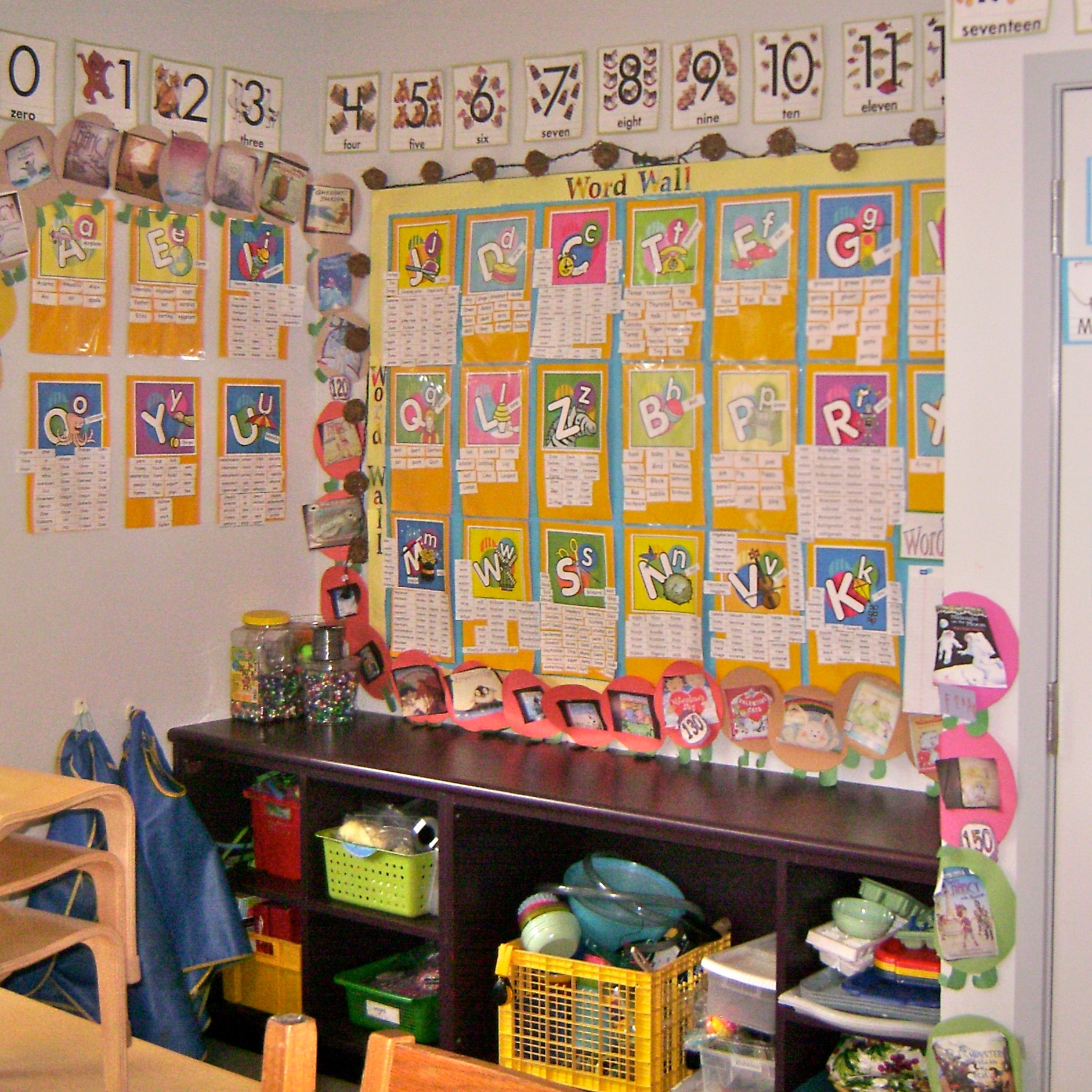
  • The walls hold the children’s art, displayed attractively, at their eye level – with large spaces of blank wall (to minimize both a cluttered look and an overwhelmed feeling when there is just too much to take in).

You belong here. So, within the classroom:

  • Each child has a cubby, basket, cot, mat – marked with his name or picture.
  • Furniture is child-sized.
  • Pictures in books, on the wall, and in the learning materials include people from different backgrounds – children within the classroom are represented in all of these things.
  • Each child’s work is displayed and protected.

This is a place you can trust. So, within the classroom:

  • Equipment and materials are arranged consistently so that children know where to find the things they need.
  • Shelves are neat and uncluttered, and materials are labeled so that children can make choices easily.
  • A daily schedule, with words and pictures, is displayed so that children know what to expect.
  • Routines, transitions, eating, napping, toileting, are predictable and consistent.

There are places where you can be by yourself when you want to be. So, within the classroom:

  • Small, quiet areas accommodate one or two children.
  • A beanbag chair or large pillow invites a child to be quiet and alone.
  • Headphones for cd players, tape recorders, or computers allow for individual listening.

You can do many things on your own here. So, within the classroom:

  • Materials are stored on low shelves that children can easily access; are organized logically (paper is near the markers and crayons, animals and people are near the blocks); and are located in areas where they can be used.
  • Shelves are labeled with both pictures and words, and show children where toys and materials belong.

This is a safe place to explore and try out your ideas. So, within the classroom:

  • Protected and defined quiet areas encourage small group activities.
  • Smocks and cover-ups are available for messy activities so that children can express themselves without fear of getting dirty.
  • Protected space for building block structures is clearly defined, and out of the way of “people” traffic.
  • Toys that haven’t been used for a long time are rotated, and new things added to keep children’s interest. Changing everything in the environment at once, however, can cause some children to be a bit unsettled, so prepare them in advance and keep some of their favorite, familiar things.

So, the questions are:

  • Have you thought about the power of the environment – that it can work for, or against you?
  • What positive messages do you want to convey to your children and parents?
  • And then, how can you design and arrange your classroom environments so that these messages come through – subtly and subliminally?
  • And finally, as you take a walk around the classrooms in your program, what messages do you receive from the environment?
  • Bottom line – how are you doing?

My next post will be about evaluating the environment, so stay tuned for “how it’s working,” and then some tips and strategies to use when children’s behavior indicates that something is amiss.

Posted in Early Childhood, Early Childhood Leadership, Early Childhood Teachers, Managing Early Childhood Programs, Training for Early Childhood Directors | 2 Comments